The original purpose of this blog was to present objects related to the Colonial and American Revolutionary War periods, and explain their use and history. For the most part, I've tried to adhere to those original intentions. But, from time to time, I have deviated from the original time periods and written posts about objects of more recent age. This is going to be one of those again.
Exhibited above is an object that belonged to my father, Bernard R. Smith. It consists of a piece of metal, measuring 1-1/8" by 2-3/8" The piece of metal encloses, on one side, a piece of paper stamped with the name and location: The William F. Gable Co., Altoona, PA. Below that was a line on which my father signed his name.
The backside of the object reveals that my dad's name and address were emboss-stamped into the metal.

Two arrows point in the direction above my father's name.
So what could this thing have been used for? Engraved on the edge of the small metal plate, on the side with the paper signed by my father, are the words: Charga Plate Credit Token. That should reveal the purpose of this object.
As early as the Renaissance in Europe, forms of credit were being extended by artisans and merchants to customers. It was probably discovered that it was more beneficial to the merchant to sell their goods by credit rather than being passed up by customers who could not make the purchase at the time. As the American Colonies emerged and progressed on the North American continent, and on into the Nineteenth Century, merchants continued the practice of extending credit to their customers. Surviving to the present day are journals in which local merchants would record, by hand, their customers' credit transaction records. A common phrase heard by merchants was "please put it on my account." And so they would open the journal to the customer's record and tally the purchase. In the 1950s and 1960s, in America, and perhaps in other parts of the world, companies such as the 'department' store, The William F. Gable Company located in Altoona, PA, started moving from a handwritten journal to mechanically processed records.
The object that is the subject of this post is evidence of the earliest form of credit card ~ used in the mechanical process of documenting the transaction in which a merchant would extend credit to the customer. This small card was kept by the customer: my father, Bernard R. Smith. When he wanted to purchase a commodity at The William F. Gable Company, but didn't have the ready cash to do so, he would present this little metal card to the clerk. The clerk would place the card, backside upward, in the proper slot of a special 'printing' machine. Overtop the card would be placed a paper form, which was actually a combination of a slip of paper and a piece of carbon paper (paper coated on one side ~ the side facing the plain paper ~ with a film of carbon-based ink). A handle on the machine would then be passed back and forth across the paper slips and the small metal credit card. Pressure from the handle would push down on the paper and carbon paper, causing the embossed letters of the metal credit card to be pressed into the paper/carbon paper slip. Functioning like a miniature printing press, the impression on the card would be 'printed' onto the paper slip. The clerk, with a quick back and forth motion, would imprint the customer's name and address onto the 'sales slip.'
Unlike today's credit cards, there was no magnetic strip to trigger the 'impression' of the customer's name and address, and that little printing press machine eventually was transformed into an electronic reader with a slot through which the card is passed. And not only is that a benefit of convenience: no longer is there any carbon paper to smudge and smear onto the clerk's fingers.
Everyone knows that teigbehalter is the German name for dough tray. But if you didn't know that, don't worry, most people who don't speak German didn't know it either.
Anyways, as you might have guessed, this post is going to be about the dough tray, variously: doughtrey. It was a piece of furniture for the kitchen, which was essentially a cupboard. A housewife would prepare her bread and/or pie dough on a table, and then she would lift the lid of the dough tray and place the dough inside it to rise. The dough tray provided for the dry, cool spot that dough required to rise properly. The dough tray pictured here dates from the 1860s to the 1920s. As you can see in the two photos below, the lid is not attached to the dough tray itself, but just sits on it and then is llifted off for access.
The dough tray, a large bowl-shaped form covered by a lid, developed from the dough bowl, which was simply a wooden bowl into which the dough would be placed, and then be covered by a piece of cloth, such as a dish towel.
The accompanying photo shows a wooden bowl sometimes used to hold dough when it was prepared for rising.
I have a thing that lies on my bookshelf collecting dust. That thing is a hunk of glass. And so, you might ask, why would anyone have a hunk of glass lying on his bookshelf?


The hunk of glass started out as a hunk of iron ore stuck in some rocks along with a bunch of other stuff. At some time in the 1830s or 40s, that hunk of iron ore (stuck in some rocks along with a bunch of other stuff), was wrenched from its home, probably by a Irish immigrant using a pickax, and dumped, like so many other hunks of iron ore, into the open top of a furnace.
You see, the hunk of glass is actually the refuse of the ironmaking industry that thrived in this south-central region of Pennsylvania in the 1800s.
Starting in the year 1828, Peter Shoenberger, a wealthy ironmaster from Pittsburgh, began to build a series of iron furnaces and forges throughout this region. He named them after his daughters, including: Sarah, Martha, Maria and Rebecca. Shoenberger also bought up large tracts of land in the region in order to obtain the iron ore, limestone and wood that would be needed to operate the furnaces.
The ironmaking process was not really all that complicated. Iron ore would be dug out of the ground, and then dumped into the open top of the iron furnace by workers (mostly Irish immigrants fleeing from their homeland because of the potato famines) using wheelbarrows, or by carts drawn by mules.

The purpose of filling the furnace with the iron ore would be to heat it until the metal melted out of the rock to which it was attached. Wood was cut into standard lengths and then stacked in the form of a truncated cone by a collier, a man who burned the stack slowly in order for it to turn into charcoal, which would then be used to fire the furnace. Limestone was quarried out of the ground and then heated in its own small furnace before being stacked in piles in an open field, where it would be rained upon and allowed to slake, or crumble, into limestone dust. Then it would be dumped into the furnace to help cause the various 'impurities' to separate from the iron as it melted. The furnace would be located alongside a river so that the energy of the moving water could be harnessed to turn machinery gears that operated large bellows to pump air into the furnace when necessary.
As the iron ore melted and separated from the impurities in the rock, small access holes near the bottom of the furnace would be unplugged and knocked open.
This allowed the molten iron metal to flow out of the furnace and into a main trench and numerous offshoots dug into the ground. As the outside air hit the hot metal emerging from the furnace, the furnace was said to "blast" with an explosion of sound that could be heard for up to ten miles around. (Many people called the iron furnace a blast furnace for that reason.) The molten iron, leaving the furnace and pouring into the trenches and their offshoots, formed what was called the sow and pigs ~ hence the name pigiron for the initial product drawn from the furnace. After the pigiron was pounded, heated and pounded again many times in an adjacent iron forge, it was given the name of wrought iron.
So we now come to the thing that lies on my bookshelf collecting dust.
It is a piece of glass, like I previously stated, but it is not glass that was intended to be glass. Instead, it is a piece of glass that formed in the iron furnace (the Sarah Furnace near the town of Claysburg to be exact) when the limestone dust caused sand and other impurities to separate from the iron. Commonly called slag, the stuff that comprised the impurities would sometimes fuse together into, among other refuse, glass. After the molten iron would be completely drained from the furnace, the remaining mass of impurities would be raked out of the furnace, and transported to a dump heap by those same Irish workers using either wheelbarrows or mule-drawn carts.
The thing that lies on my bookshelf collecting dust lay on that dump heap for 150 years before being retrieved by a friend of mine while out for a walk, who in turn gave it to me (when I saw it on her desk at work, and exclaimed "Wow! That's a beautiful piece of slag!").
What might not be seen in the photos of this piece of slag is the intensely beautiful green color. And what can't be experienced by this blog's readers is the razor sharp edges ~ it is real glass!
 A neighbor and I were talking the other day about some of the things we enjoyed when we were young (in the 1950s-60s), and inevitably the discussion led around to foods.
Now, it is important that you know that I was born in the south-central region of Pennsylvania, where, in the 1760s, the earliest settlers (which included most of my ancestors) consisted of intermarried Germans and Ulster Scots. (The old people called them, the Scotch Irish.) In the eastern part of the state of Pennsylvania, the German and Swiss families congregated in their own communities, separated from the "English" (which meant everyone other than German). The Ulster Scots tended to settle among the English, Scottish and Irish communities, but did not separate themselves as completely as the Germans and Swiss. Since Great Britain had taken possession of the lands east of the Ohio and Mississippi River valleys, the county seats and their local governments were largely settled, and controlled, by the English, Scottish and Irish. And as all the groups of settlers moved westward into and across the Appalachian Mountain range, and into the plateau region of present-day Pittsburgh, the Ulster Scot settlers tended to make their settlements on the slopes or tops of the major mountains in the Appalachian range, while the Germans chose the valleys for their rich farming soil. As a result, the hill and valley region that makes up the south-central region of Pennsylvania became fairly evenly populated by both German/Swiss and Ulster Scot families. They were bound to intermarry.
So, you ask, what is the point of all this demographic history? The point is that while the English, Scottish and Irish communities spoke "English", and the German and Swiss communities spoke "Pennsylvania Dutch", the people of the south-central region of Pennsylvania spoke a combination of Pennsylvania Dutch and Scotch-Irish (a form of speech which is recognized by some linguists as a sub-dialect of Pennsylvania Dutch). And not only is the region unique linguistically, it is noted for certain things that have come out of it, or flourished in it.
And that leads me to the discussion my neighbor and I were having the other day. We both remembered enjoying butterbread with sugar on it ~ a delicacy that we called sugarbread. Now both English and German people, even in other parts of the state of Pennsylvania, will say that they also remember eating buttered bread and buttered bread with sugar. But we never ate 'buttered' bread; we ate butterbread. And we never ate 'buttered' bread 'with sugar'; we ate sugarbread. There was nothing about it that made either butterbread or sugarbread indicative of being poor and needy (as some people like to surmise). We ate it because it was delicious! In the Smith household, eating sugarbread was not something we did because we had no other food ~ sugarbread was a treat. My grandfather, Eldon Smith, and in turn, his son, my father, Bernard Smith would help us to butter our slice of bread thick enough that no original bread could be seen below the yellowy goodness of the butter. And then we would spoon sugar over the whole surface to hide the yellow of the butter. Pap (my grandfather, Eldon) would say that we were to put on enough sugar to be able to track a rabbit in. That meant that we would then hold our second and middle fingers together and poke the tips into the field of sugar, jumping them like a rabbit, across the width of the piece of bread to leave the 'tracks' - our little double fingerprint holes.
And then there was coffee-soup. As a child, coffee-soup was the only way that mom would let us ingest that dreadful hot beverage that we were told would stunt your growth if you drank a cupful of. A plate that would hold a slice of bread would be filled with coffee. Then the ceremony would begin. You had to be ready to do all of the steps or else the process would be doomed to failure. You first got a piece of bread and you would dip it flat down into the coffee so that the underside would get saturated with the coffee. But you dare not leave it there for very long; you had to quickly turn it over so that the 'dry' side would become saturated too. If there were any dry spots after the coffee had all soaked into the bread, you couldn't fix it. It was 'illegal' to pour any more coffee onto the bread - dry spots or not. And as soon as the bread had been turned over, with every inch of it becoming saturated with the coffee, you had to spoon sugar all over the surface ~ again about enough to be able to track a rabbit in. And even before all of the sugar would turn brown from the coffee, you would take your spoon and start eating. In a way, I thought it was a treat even better than ice cream ~ perhaps because it was made of that most forbidden nectar - coffee.

The funny thing is that even today I love coffee-soup, but I really never acquired a taste for coffee; I prefer hot chocolate and/or tea. One time, in the recent past, I decided to try "hot chocolate-soup". I figured that since coffee produced such a wonderful delicacy, hot chocolate would produce an equally wonderful dish. I was very wrong; it didn't taste good at all. I think maybe I tasted the bitter flavor of sacrilege, and so I vowed to stick with coffee in my coffee-soup.
I should add one final note to this post ~ Never, ever, ever mix butterbread and coffee-soup. I'm sure of two things: Such a concoction will not be tasty. And by screwing with something that our intermarried German/Swiss and Ulster-Scot families came up with, your soul will be condemned to everlasting torment in the bowels of a place other than Heaven.

There are two types of things: Some items are easily and readily identified for exactly what they are by everyone. Then there are those things that are created and used by one group of people, but are a mystery to everyone else.
The subject of this post is one of the second sort of thing. If the viewer belongs to either the Orthodox Christian or the Greek Catholic (Byzantine) church, he/she will immediately know what the object illustrated is (or is used for). Everyone else will probably make a guess about it, but will probably be incorrect in that guess.
I'm neither Orthodox Christian or Greek Catholic. So when I saw this item in an antique shop recently, I thought it was either a butter press or a printing block used to apply a pseudo-stencil onto a wall. The antique dealer had no idea what it was. I didn't really care what it was; I just wanted it because it looked interesting and old.
If I had been either Orthodox Christian or Greek Catholic, I would have known that this object was actually a bread press used to press a design into dough ~ similar to how a butter press is used.

A leavened bread, known as a prosphora when stamped with this press, was used in the Divine Liturgy (Eucharist). The dough, made from wheat flour, water and salt, is unique in that the ingredients are mixed together and then set aside for a week to evolve into a sourdough ball from which its own yeast can be derived. The sourdough ball is crumbled into a bowl of water, and in time it starts to bubble as the natural yeast brews. More flour is added, and the resulting dough is kneaded by hand until all the air is forced out. Two-thirds of the dough is formed into a large, round patty and the remaining one-third is formed into a smaller, round patty. The small patty is stacked on top of the large patty (their matching surfaces having been brushed with water so that they'd stick together), and then the press, which will have been dusted with a bit of flour, is positioned on top of the stack. The press would be pushed down into the dough, compressing the small patty almost completely into the large patty. The press, stuck in the dough, is left for three or four minutes, allowing it to be loosened and more easily extracted. The dough is then heated to complete the bread-making process.
The design inscribed on the press that I own is the same as the design on all other prosphora presses. It includes a cross comprised of five squares. The central square is referred to as the Lamb. It is divided into four smaller squares which hold Greek letters IC XC NIKA, which translates as "Jesus Christ conquers." The squares above and below the central square, are copies of the central square.
The square to the right of the central square contains nine triangle shapes in three rows of three, called the Nine Ranks. The square to the left of the central square, called the Panagia, is a representation of the Virgin Mary. The handle, on the backside of the press, is a copy of the central square, or Lamb.

During the late-19th and early-20th Centuries, a woman's make-up case was a thing of beauty in itself.
The make-up case, like the one shown here, might have been intended to be placed and kept on a lady's make-up table ~ or ~ it might have been intended to be taken with her when she traveled. In any event, a case such as this one, would have added a touch of elegance to the lady's boudoir.
This make-up case dates from the 1920s or 1930s. It consists of a wooden box covered with varnished paper. The inside is covered in pink and green silk material. Underneath the silk material are structural forms designed to hold various cosmetic tools, including a mirror and hairbrush.
Because of the fact that the case does not possess a handle, and the bottom was not covered by the varnished decorative paper, it would appear that this makeup case was not designed to be carried about. It would have been kept on a lady's makeup table or on a dresser in her bedroom. It will be noticed that the mirror is located on the inside of the lid, so that whenever the lid is in the open position it could be used as a free-standing mirror, leaving the lady's hands free to apply her makeup.
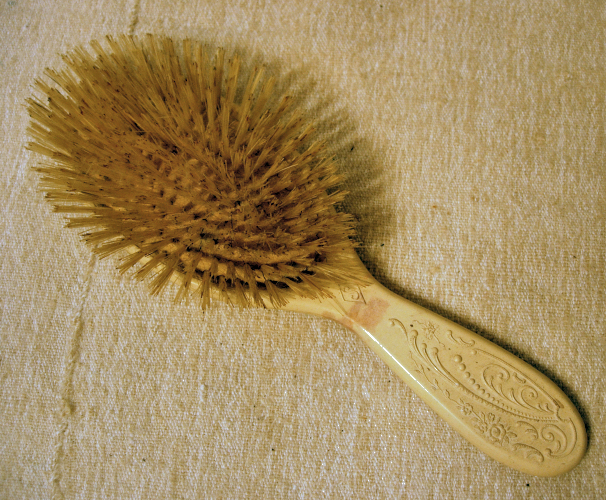
The make-up case held the mirror, a hair brush, multiple shoe button-hooks and small round packets of make-up powder.
The photo shows two slightly worn "Indian head", or "buffalo" nickles. These two piece of U.S. currency date from 1917 and 1923, and apparently from the smoothed features, they were used quite a bit during their lifetimes.
These, so-called, Indian head nickles are relatively inexpensive by modern-day numismatic standards. They were minted between 1913 and 1938. And, because the images have become smoothed over quite a bit, the mint marks are not readable. The 1917 nickle, having been circulated, would be worth between $4.10 and $50.00. The 1923, being a bit more common, would fetch between $4.00 and $40.00.
I have no interest, though, in trying to get a fortune out of these two pieces of 75% copper and 25% nickel. I have no interest in the coins' numismatic value because their value lies in the job they fulfilled during their lifetimes. Yes, these coins performed a duty that most coins cannot aspire to.
These two small, round pieces of copper/nickel metal paid for my great-grandfather's soul to pass into Heaven.
Prior to the 1900s, people were superstitious in a world that was just beginning to have its secrets explained by science. Various superstitions involved death and the dead body, two of which are here noted because they have to do with coins. The first of them was that if the eyes of a dead person opened during the 'wake', the first person on whom the eyes glanced would be doomed to death soon. In other words, the belief was that the dead person would be looking for someone to accompany them to Heaven. To avoid such a fate from happening, the deceased one's surviving relatives would place something over the eyes to keep them shut. Most often that something was a coin. The second superstition regarding coins and the dead recalled a belief held long ago by the Greeks. The Greeks and their cultural descendants believed that the souls of the dead traveled to Hades, the underworld. And to get there, the soul had to cross over the river Styx. The only way to safely get across the river Styx was by riding a ferry boat operated by the ferryman, Charon. And the only way that Charon would allow the soul to board his ferry boat was to pay him with a couple coins. For that reason, when a person died, a coin or two were placed inside the dead person's mouth to ensure that their soul would have the required payment for Charon. Much later, perhaps in the Sixteenth or Seventeenth Centuries, the practice of placing the coins on the dead person's eyes was found to, as it were, 'kill two birds with one stone'. The coins were there to pay the ferryman, and the eyes could be kept from opening.
The practice of placing coins either in the mouth or over the eyes of a dead person continued to be popular in the Western World and among Christians up to the 1900s. And in some places, such as in the Appalachians, where German and Ulster Scot families resided for generations, the practice continued even into the 20th Century. And that is where we come to the death of my great-grandfather, Aaron Bowser. He died in 1945 in the region of Blair County, Pennsylvania known as Smith Corner. Aaron and his wife Linnie spoke German in private, and a form of 'dutchified English' in public. Their family was neither well-to-do nor dirt-poor. Their habits and customs were those handed down from their Eighteenth Century immigrant ancestors.
And so, when Aaron died in 1945, these two buffalo nickles were placed over his eyes out of habit and custom. But new superstitious beliefs must have induced a family member to remove the coins from Aaron's eyes before his casket was consigned to the grave.