My younger readers might not ever have heard this, but the older ones probably did once or twice when they were young: "If you don't behave, you'll get a scutchin'."

I grew up in a day and age in which it was clearly demonstrated that children who were disciplined by physical means tended to behave themselves ~ as compared to the present time, in which the kids run wild while the parents cower in fear that their neighbors might see a cut on one of the child's arms, and turn them in to the police for abuse. And, amazingly enough, not all of us 'disciplined kids' grew up to be mass murderers or leaders of al qaeda sleeper cells. Parents, in days past, often used a wooden paddle of some sort to correct the children who misbehaved ~ a single swat against the gluteus maximus got the child's attention, and guess what? It sometimes induced them to listen to their parents and stop misbehaving. I remember hearing my mother say that the reason God made the butt so well cushioned with muscle (i.e. the gluteus maximus) and fat was so that a child could be paddled there and it would not disable the child for the rest of his or her life. Despite what behavioral psychologists might want you to believe, very few children ever died from being paddled on the tush.
Now why would the parent say that the child would get a scutchin' if they misbehaved, when what they meant to say was that the child would get a paddling? Maybe because scutchin' sounds better than paddling sounds.
Actually, the reason for the use of the word scutchin' comes from the name of the wooden paddle that most parents had in their houses ~ albeit a generation or two back. In the day and age in which each household had to produce the yarn they needed for weaving cloth, they had to remove the hulls from the flax stalks. They performed that job by first breaking the flax on a flax break, and then, holding a bunch of the broken flax stalks over a stump or chair seat, they would strike at the stalks with the scutching knives, causing most of the pieces of hull, or the straw, to be knocked off of the stalks, leaving only the useable fibers. Lastly, the fibers would be pulled through a hatchel, or flax comb, to remove any remaining pieces of hull.
The word scutching comes from the late 17th Century Old French word escoucher, which, derived from the Latin, excutere, meant "to shake." The wooden paddle used to 'scutch' the flax became known as a scutching knife. And, by extension, the action of using the scutching knife became known as giving the flax a scutchin'.
As the years went by, and the need for housewives to spin their own yarn went by the way, the use of a scutching knife to knock the hulls off the flax fibers was an activity that likewise fell by the wayside. But the parents of the family retained the scutching knife, and used it to paddle the children when they misbehaved. There was no need to make a wooden paddle, when one was readymade in the form of the scutching knife.
Do you know what a thude-weald was? In the 1700s, a thude-weald was a person who looked after the woods ~ in other words an occupation similar to a game warden today.
And how about the neck-stamper? In the early 1800s, the neck-stamper was (usually) a young boy who collects pots and other containers belonging to an alehouse, which had been used to send beer to private houses.
I'm sure you know what an ostler did. He was basically a stableman who took care of the horse(s) for someone staying at an inn. But, although you probably already knew what an ostler was, do you know what a daisy-kicker did? This was a trick question; the name daisy-licker was just another name for an ostler.
The pellipar was a very necessary occupation at a time when animal skins were utilized in clothing, because he was a dresser or skinner of those animal hides.
And finally, one of the most popular occupations back then was that of the xylopola ~ which, no doubt, everyone knows was a woodmonger ~ and, I'm sure, everyone knows one who sold wood to others.
There's a rather extensive list of Occupations, Professions & Offices Of Our Colonial Ancestors on the Mother Bedford website at: http://www.motherbedford.com/Occupations.htm
I just wanted to remind my American visitors that today was George Washington's birthday. He was born on 22 February 1732.
You can read a number of articles regarding George Washington on my website, Mother Bedford, at:
http://www.motherbedford.com/Washington02.htm

As you walk through an antique shop or mart, you come across many things that are interesting, but which baffle you as to for what purpose they were intended. Sometimes the age of the piece is the simple enticement to own the item; sometimes the design of the item entices one to buy it. Sometimes, as with the item shown above, the design, combined with the rich patina of age, captures the eye of the buyer.
Although the two or three most recent generations of people would not believe it, at one time, beds did not have mattresses constructed of cloth, foam and other soft materials. Way, way back, a bed's mattress was constructed of a large, flat cloth bag that would have been filled with straw and feathers ~ more feathers than straw if you were lucky.
The old mattresses were more comfortable than nothing (try sleeping on the floor for a while and you'll probably think a straw mattress is the most wonderful thing to have). A problem with the straw and feather mattress was that the materials would bunch up, making thick and thin spots. That's why the wooden object shown above, the subject of this post, was an important tool of the housewife.
This object is called a bed paddle. The housewife would use the bed paddle to slap the thick, bunched up portions of the mattress in order to smooth it out a bit. You couldn't just grab the mattress and shake it ~ that would simply make the straw and feathers bunch up in different spots. The bed paddle was a tool that, although a little heavy, was easily handled by the housewife. As she slapped it down onto the mattress, the straw and feathers in bunched up spots would be forced to level out. So with four or five slaps of the bed paddle, the housewife would have the bed's mattress smoothed out and ready for the next night's (better than nothing) restful sleep.
Notice in the photo below that this particular bed paddle was dated 1842.

The cross-cut saw was a tool that had to be operated by two men, forcing them to work together in unison; they were forced to cooperate or else they'd have problems.
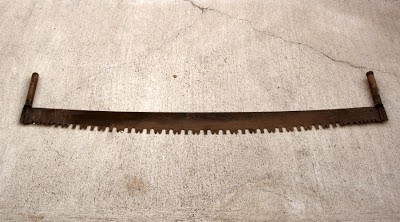
Before the gas-powered chain saw was invented, woodsmen used these long flat saws to cut down standing trees and also to cut a felled tree into manageable lengths. Each of two men would grasp their respective handles with both hands. Then, one of them would pull the saw forward, with the other man holding on but allowing the saw to be pulled away. As the saw reached its length and could be pulled no farther, the other man would tighten his grip and pull the saw toward himself. The first man, in turn, loosened his grip, allowing the saw to be pulled away from himself. This give and take, pull and release, continued until the tree was completely sawn through. The cross-cut saw was easier to use in cutting up a felled tree than in cutting down a standing tree. In the latter instance, the two men would be required to hold the saw horizontally, and it would have been difficult to apply pressure on the cutting edge. Cutting up a felled tree would take advantage of gravity to apply pressure on the cutting edge.

The cross-cut saw shown here measures fifty-nine inches (just less than five feet) in length.
This post has nothing to do with an item from our Colonial Period, but it came to mind, and I thought readers might enjoy it.
My great-great-great-great-great-great-great-great-great-great-great-great-great-great-great-great-great-great-great-great-great-great-great-great-great-great-great-grandmother (that's 27th great-, or 30 generations back, grandmother), Margaret of Wessex, a granddaughter of English King Edmund Ironside / daughter of Edward the Exile, and husband of Scottish King Malcolm III (Caenn-Mor), is credited with initiating the placement of buttons on the cuffs of men's coats.
Margaret, who was canonized as Saint Margaret by Pope Innocent IV in the year 1250, gained her sainthood as a result of her charitable work for the poor and sick of Edinburgh and the surrounding area, and her encouragement in the establishment of monasteries at places including Dumferline and Iona.
A number of stories about Margaret were circulated during her lifetime and after, one of which is the basis for this post. It has been claimed that Margaret was disgusted by the habit of men blowing and wiping their noses on the cuffs of their coat sleeves. She had buttons sewn on the cuffs of the coats of all the men attending at her court. The intention was for them to hurt their noses when they attempted to wipe their noses on their sleeves.
Another tradition claims that it was Frederick the Great, King of Prussia in the 1700s, who started the practice of sewing buttons on coat sleeves when he was offended by seeing his soldiers wiping the sweat from their brows onto their sleeves. He, as stated in the tradition of Saint Margaret, supposedly had buttons sewn on the cuffs so that the soldiers would cut their eyes as they wiped their brows.
Yet another tradition claims that it was Catherine the Great of Russia who started the cuff button practice.
Perhaps the Frederick the Great tradition is correct, perhaps the Catherine the Great tradition is the correct one, but since I descend directly from Margaret through the Mackintosh, Shaw and then Smith lines, I prefer to believe her tradition.
Nowadays, we tend to go to the store (most likely a Walmart), buy and item fabricated thousands of miles away (probably halfway around the world, in China), take it home, use it a couple times and then it breaks or stops working. So what do we do? We go back to the store, buy another of the same item (since there are twenty of them on the shelf) and start the use / discard / repurchase process all over again.
During the Colonial Period and the time of the American Revolutionary War, there weren't many stores where someone could conveniently buy the items they needed. In many cases, the person had to make the item him or herself ~ or else they made do without it. That is where the phrase Necessity Is The Mother Of Invention comes in.
During the Colonial Period, when someone needed something that they could not readily purchase, they resorted to finding something that would suit their purpose. Or they would find something that could be adjusted ~ they called it jerry-rigged ~ to suit their purpose. The item shown below is just such an item that was found to suit another purpose. Necessity motivated a person to invent this item out of another.
The item above is a bullet bag in which a soldier during the American Revolutionary War carried his bullets and other shot. The bullet bag is made of leather; cloth bags would have worn and become useless much faster than leather. Bullet bags, such as this, could have been made by cutting two similarly shaped pieces of leather and then sewing them together around their edges. The sewing would have been as difficult as any other leather item being sewn, and the sewn edge would have, like a cloth bag, been more quickly susceptible to tearing open.
The necessity of finding something of leather that could be used for holding bullets and the like that was already in the shape needed, led soldiers to using animal (especially bull) scrotums. They would be tanned and the open end fitted with a wooden or bone cylinder that would enable the bag to be stoppered shut.
The picture above shows three bullet bags from the American Revolutionary War period, the one in the center and the one on the left were made the laborious way of sewing two pieces of leather together. The soldier who had either of those two bags fabricated, would have had to spend a quite a bit to have them made by someone else ~ or else he spent a lot of time and effort making them himself. The one on the right, being the one illustrated at the top of this post, was the product of necessity, and probably cost very little to the soldier.


