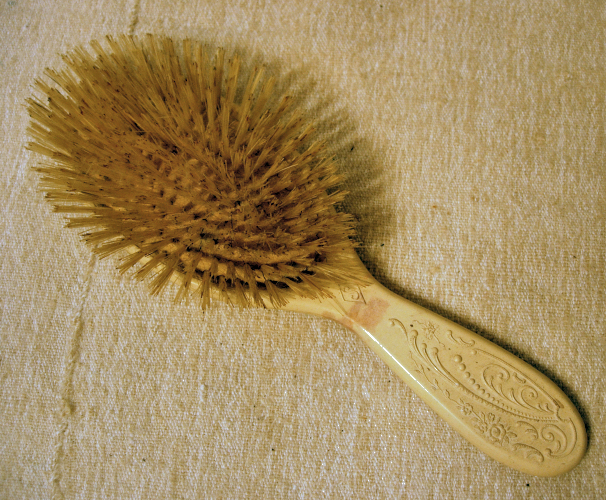
There are two types of things: Some items are easily and readily identified for exactly what they are by everyone. Then there are those things that are created and used by one group of people, but are a mystery to everyone else.
The subject of this post is one of the second sort of thing. If the viewer belongs to either the Orthodox Christian or the Greek Catholic (Byzantine) church, he/she will immediately know what the object illustrated is (or is used for). Everyone else will probably make a guess about it, but will probably be incorrect in that guess.
I'm neither Orthodox Christian or Greek Catholic. So when I saw this item in an antique shop recently, I thought it was either a butter press or a printing block used to apply a pseudo-stencil onto a wall. The antique dealer had no idea what it was. I didn't really care what it was; I just wanted it because it looked interesting and old.
If I had been either Orthodox Christian or Greek Catholic, I would have known that this object was actually a bread press used to press a design into dough ~ similar to how a butter press is used.

A leavened bread, known as a prosphora when stamped with this press, was used in the Divine Liturgy (Eucharist). The dough, made from wheat flour, water and salt, is unique in that the ingredients are mixed together and then set aside for a week to evolve into a sourdough ball from which its own yeast can be derived. The sourdough ball is crumbled into a bowl of water, and in time it starts to bubble as the natural yeast brews. More flour is added, and the resulting dough is kneaded by hand until all the air is forced out. Two-thirds of the dough is formed into a large, round patty and the remaining one-third is formed into a smaller, round patty. The small patty is stacked on top of the large patty (their matching surfaces having been brushed with water so that they'd stick together), and then the press, which will have been dusted with a bit of flour, is positioned on top of the stack. The press would be pushed down into the dough, compressing the small patty almost completely into the large patty. The press, stuck in the dough, is left for three or four minutes, allowing it to be loosened and more easily extracted. The dough is then heated to complete the bread-making process.
The design inscribed on the press that I own is the same as the design on all other prosphora presses. It includes a cross comprised of five squares. The central square is referred to as the Lamb. It is divided into four smaller squares which hold Greek letters IC XC NIKA, which translates as "Jesus Christ conquers." The squares above and below the central square, are copies of the central square.
The square to the right of the central square contains nine triangle shapes in three rows of three, called the Nine Ranks. The square to the left of the central square, called the Panagia, is a representation of the Virgin Mary. The handle, on the backside of the press, is a copy of the central square, or Lamb.

During the late-19th and early-20th Centuries, a woman's make-up case was a thing of beauty in itself.
The make-up case, like the one shown here, might have been intended to be placed and kept on a lady's make-up table ~ or ~ it might have been intended to be taken with her when she traveled. In any event, a case such as this one, would have added a touch of elegance to the lady's boudoir.
This make-up case dates from the 1920s or 1930s. It consists of a wooden box covered with varnished paper. The inside is covered in pink and green silk material. Underneath the silk material are structural forms designed to hold various cosmetic tools, including a mirror and hairbrush.
Because of the fact that the case does not possess a handle, and the bottom was not covered by the varnished decorative paper, it would appear that this makeup case was not designed to be carried about. It would have been kept on a lady's makeup table or on a dresser in her bedroom. It will be noticed that the mirror is located on the inside of the lid, so that whenever the lid is in the open position it could be used as a free-standing mirror, leaving the lady's hands free to apply her makeup.
The make-up case held the mirror, a hair brush, multiple shoe button-hooks and small round packets of make-up powder.
The photo shows two slightly worn "Indian head", or "buffalo" nickles. These two piece of U.S. currency date from 1917 and 1923, and apparently from the smoothed features, they were used quite a bit during their lifetimes.
These, so-called, Indian head nickles are relatively inexpensive by modern-day numismatic standards. They were minted between 1913 and 1938. And, because the images have become smoothed over quite a bit, the mint marks are not readable. The 1917 nickle, having been circulated, would be worth between $4.10 and $50.00. The 1923, being a bit more common, would fetch between $4.00 and $40.00.
I have no interest, though, in trying to get a fortune out of these two pieces of 75% copper and 25% nickel. I have no interest in the coins' numismatic value because their value lies in the job they fulfilled during their lifetimes. Yes, these coins performed a duty that most coins cannot aspire to.
These two small, round pieces of copper/nickel metal paid for my great-grandfather's soul to pass into Heaven.
Prior to the 1900s, people were superstitious in a world that was just beginning to have its secrets explained by science. Various superstitions involved death and the dead body, two of which are here noted because they have to do with coins. The first of them was that if the eyes of a dead person opened during the 'wake', the first person on whom the eyes glanced would be doomed to death soon. In other words, the belief was that the dead person would be looking for someone to accompany them to Heaven. To avoid such a fate from happening, the deceased one's surviving relatives would place something over the eyes to keep them shut. Most often that something was a coin. The second superstition regarding coins and the dead recalled a belief held long ago by the Greeks. The Greeks and their cultural descendants believed that the souls of the dead traveled to Hades, the underworld. And to get there, the soul had to cross over the river Styx. The only way to safely get across the river Styx was by riding a ferry boat operated by the ferryman, Charon. And the only way that Charon would allow the soul to board his ferry boat was to pay him with a couple coins. For that reason, when a person died, a coin or two were placed inside the dead person's mouth to ensure that their soul would have the required payment for Charon. Much later, perhaps in the Sixteenth or Seventeenth Centuries, the practice of placing the coins on the dead person's eyes was found to, as it were, 'kill two birds with one stone'. The coins were there to pay the ferryman, and the eyes could be kept from opening.
The practice of placing coins either in the mouth or over the eyes of a dead person continued to be popular in the Western World and among Christians up to the 1900s. And in some places, such as in the Appalachians, where German and Ulster Scot families resided for generations, the practice continued even into the 20th Century. And that is where we come to the death of my great-grandfather, Aaron Bowser. He died in 1945 in the region of Blair County, Pennsylvania known as Smith Corner. Aaron and his wife Linnie spoke German in private, and a form of 'dutchified English' in public. Their family was neither well-to-do nor dirt-poor. Their habits and customs were those handed down from their Eighteenth Century immigrant ancestors.
And so, when Aaron died in 1945, these two buffalo nickles were placed over his eyes out of habit and custom. But new superstitious beliefs must have induced a family member to remove the coins from Aaron's eyes before his casket was consigned to the grave.

For the past five days I have had the pleasure of hosting a common cold. I am a bit saddened, though by the realization that my new friend's visit is almost half over already. As they say ~ "Time flies, when you're having fun!"
In my previous posts, I have tried to include a photo of some object that I own. So when I got ready to write this, I looked for a common cold molecule that I could photograph and post. Unfortunately, they were all hiding up in my sinus cavities, and I did not have any from any previous visits, so I had to create an image. It looks pretty much like an actual rhinovirus molecule. So please use your imagination and pretend it is a photo of the real thing
Anyways, the reason for creating this post was to note the history of the name: common cold.
The State Papers of Henry VIII notes, in the year 1537, that: If I take any cold, incontinent the lax commythe agayne. In 1679 it was reported: His Majesty... has been indisposed for some days by a Cold he took. The word cold, combined with the word common, meaning "shared between two or more", became popular in the 1500s, apparently the result of a comparison of its symptoms with those of exposure to cold weather. Prior to an understanding of the science behind things, and when the cause of this disease was a mystery to all, it was noticed that it became more prevalent during cold weather.
While we today have many medicines that purport to alleviate the symptoms of the common cold, there exists not any one single cure for the common cold. During the Colonial Period of the United States of America, certain herbs were known to help relieve the irritating symptoms of the common cold. Hyssop, a member of the mint family, was known to ease respiratory irritations if taken as a tissane (what most people call tea). Horehound and Marshmallow, being high in mucilage worked similarly to hyssop. Infusions (in which the water-soluble substances are extracted from plants by soaking in water) of yarrow, elder and peppermint; of bayberry and ginger; and of boneset, elder, yarrow and ginger were old 'cures' for colds. Coughs might be relieved by a decoction (where the essential oils of a plant are obtained by boiling the plant) of elecampane, white horehound, coltsfoot and fennel. Sore throats were soothed by an infusion of Goldenseal, Thyme, Sage and Myrrh.
The 'herbal' treatment that I plan to use this evening is that concoction used by my Scottish ancestors ~ a hot toddy (one teaspoon of sugar, one teaspoon of honey, a shot of delicious Scotch whisky and boiled water).
My brother, Leon (who was one year older than me), and I enjoyed 'hanging out' at my paternal grandparents' house.
My grandfather, Eldon Smith (whom we called, Pap), would look at Leon, and say: "Hey Boy, hand me that newspaper over there." A little later on, I would be getting a drink of water at the kitchen sink. Pap would call out to me: "Hey Boy, take that cup up to the shed and get me some cider."
Now I should point out ~ neither I, nor my brother, was ever offended by the fact that Pap called me, and/or him by the common name of Boy. What might have angered someone else at Pap's use of the seemingly derogatory or condescending name was endearing to me and my brother. We actually laughed about it at times; we figured that he couldn't remember our names, and so he just used the name Boy for both of us. As the years passed, and long after Pap was laid to rest, Leon and I called each other "Boy", probably to the amusement of others hearing us.
In any case, this post wasn't just meant to be about my grandfather and what he called me. It actually was meant to be about perry - and its cousin, cider. (That explains the photo of pear blossoms at the top of this post.)
Most people are familiar with, and enjoy drinking, apple cider ~ especially in the Autumn, when fresh apples are harvested. What they might not be so familiar with, and perhaps have never even tried, is the same drink, albeit made with pears ~ perry. Whether to extend the amount of drink to be made from one's available harvest, or whether for the blended taste, pears might be added to the apples as they were being mashed into cider. But the pears, alone, would produce an enjoyable drink similar to cider.
Now, it's no secret that through the years since the Colonial Period, most cider was drunk in its hard form, meaning after it had fermented and become 'alcoholic'. Perry, made from pears, would also undergo fermentation due to the presence of lactic acid bacteria in the pears. In the 'old days', before the use of refrigerators to keep food and drinks cold ~or~ before liquids could be sealed in glass or metal containers to preserve their freshness, cider and perry was stored in wooden casks and barrels. The tannic acid in the wood of the barrel would encourage the fermentation.
When my grandfather would take apples and pears to the press to have them mashed, he would obtain enough cider and perry to fill two large barrels ~ about twenty or thirty gallons worth. The two barrels would then last Pap and my grandmother through the whole winter and into the next spring and summer. The longer the cider lasted, the harder it got.
To return to something I noted above ~ When Pap would tell me to take the cup up to the shed to get him some cider, he would be referring to the tin cup that was kept on the kitchen sink. Everyone used that same cup when you wanted a drink of water ~ or cider. Of course, after using the cup you were expected to rinse it out. Anyways, when told to get him some cider, Pap was directing me to take the tin cup, and to go to the small shed beside the barn that stood on a slightly sloping hill ~ in which the barrels were kept ~ positioned on their sides and nestled on X-shaped cradles. On each barrel, a wooden spigot had been pounded into a bung hole. I'd hold the tin cup under the spigot and turn the 'handle', meaning I'd loosen the wooden stopper so that the cider or perry would flow through the spigot. I'd then carefully carry the cup full of cider down the slope of the hill to give to my waiting grandfather.
Oh, I almost forgot to mention ~ I usually stole a 'sip' out of the cup myself before taking it down to Pap. I thought I was getting away with something ~ because we kids were not supposed to drink the cider after it had turned hard ~ but I'm sure that Pap knew that I had taken a sip... Maybe that's why he would send me to get him a cup full instead of getting it himself.
This post doesn't have anything to do with antiques or olden times. I just thought that I would share with you all something that is most often overlooked.
Did you ever hear the phrase: "You can't see the forest for the trees"? Well, in this case, you can't see the tree for the blossoms.
So, everyone in the United States is familiar with the beautiful pink cherry blossoms that line the tidal basin in the nation's capitol, Washington, D.C. But I would bet that most, if not all, of the readers of this blog have never seen a maple blossom. Yes, you heard, or rather read, correctly ~ maple blossom. You probably believed that when Spring is breaking out all over the place, that leaves just start to sprout all over the branches of maple trees, making them green all over. The fact of the matter is that before the leaves start to come out, the maple tree blooms in lime green blossoms.
The photos on this post show the maple tree in my yard completely covered in beautiful maple blossoms. Although all of the types of maples sprout blossoms in the Spring, the Norway Maple, which is the type shown here, seems to get the nicest blooms. One source told me that the "blossom" is actually called a cluster of staminate flowers.
Most people, even those who have maple trees growing in their own yards, never see the blossoms ~ mostly because they have never actually looked at that green stuff on the tree's branches. They probably think that any green color that they see would simply be leaves coming out. And, of course, if the blossoms were white or pink, they would be more noticeable, but being green, they do resemble leaves ~ especially if you see them as you are passing by at sixty miles-per-hour in a car. While it's Springtime, get outside and enjoy your maple trees while they are flowering!
 Watermarks in paper are not the result of paper actually being marked by water. In fact, when a drop of water makes contact with a forming piece of paper, the resulting mark is considered an imperfection, and is known as a papermaker's tear (as in crying). So what's a true watermark?
If you are reading this post, you most surely know about the internet; and if you know about the internet, you possibly have heard about or seen watermarks.
Most people who have used the internet, at one point or another, will have seen an image (photo or text) with a word or logo in light grey superimposed over the image. The superimposed light grey word or logo allows the image to be viewable, but at the same time makes that image undesirable to be copied. Most people call those light grey words or logo images 'watermarks', but they are not true watermarks.

Those internet-based marks on images were given the name: watermarks, because, despite not being true watermarks, they function to provide security, which is one of the functions of a true watermark.
So we're back to the same question ~ what is a true watermark?
A watermark is an image, in the form of an individual design element, or of an overall pattern, created inside paper during the process of producing the paper. The watermark is created by causing certain areas of the pulp that makes up the paper to be thinner (or thicker) than the surrounding areas of the pulp. The watermark is normally viewed by backlighting the paper. All of the images in this post were photographed by allowing a light to shine through the paper. Hold any piece of recently printed U.S. dollar bills up to the light, and on the one side, seemingly inside the paper itself, you will see the image of the U.S. president, whose image is also included in the printed image. As light passes through watermarked papers, the areas in which the pulp was caused to be thinner will appear to be a bit lighter in shade as compared to the rest of the paper. Conversely, the areas in which the pulp was caused to be thicker will appear to be a bit darker in shade than the surrounding paper. This phenomenon is the result of variations in the opaqueness of the paper.

The watermark images displayed on this post were all created by the twisting and bending of a single strand of wire into an image, and then the attachment of the wire onto the wire mesh used in the process of making the paper. Since the strands of wire would cause the paper fibers to be thinner overtop them, the resulting lines of the watermark would be thinner, and appear white against the thicker paper 'background'.
The image created by the varying thickness in the paper itself is called a watermark merely because it is created in the paper while it still is (if ever so slightly) wet.
It is generally believed that the purpose of the watermark was originally to provide an identification of the paper manufacturer; it was essentially a signature mark. The purpose of the watermark today is primarily for security; a watermark verifies the authenticity of a document. If you get a paycheck from an employer, hold it up to the light, and you will probably see a watermark image in the paper.

Watermarks are formed by impressing a three-dimensional image in the wire mesh on which the paper fibers are laid in the process of papermaking. As the water in the paper pulp drains through the wire mesh, the paper fibers that remain will be thinner where the impressed image was thicker and thicker where the impressed image was thinner. As the paper dries, the thicker and thinner areas remain, becoming the watermark.